
Have you ever flipped over a bag of pet treats and felt your heart sink reading the ingredient list? Colours, flavour enhancers, meat by-products, preservatives you can't pronounce. If you've been searching for Australian made dog treats that are exactly what they say they are, you already understand that feeling. At Treaty Treats, we built our entire process around fixing it. Every chip starts as a single piece of real, human-grade meat and ends as a naturally crunchy treat your dog or cat absolutely loses their mind for. Here's the full honest story of how that happens.
Table of Contents
- Quick Takeaways
- It Starts with the Meat
- The Air-Drying Process Explained
- Why Batch-Made Matters
- Comparing Treat-Making Methods
- What No Additives Actually Means
- Which Pets Benefit Most
- Frequently Asked Questions
- References
Quick Takeaways
| Key Insight | Explanation |
|---|---|
| Single-ingredient sourcing | Treaty Treats uses only one ingredient per product: real, human-grade beef, chicken, or turkey. No fillers, no by-products, nothing hidden. |
| Air drying preserves nutrition | The slow, low-temperature air-drying process removes moisture without destroying the vitamins, minerals, and amino acids naturally found in raw meat. |
| No added preservatives needed | Reducing moisture to a very low level naturally inhibits bacterial growth, making the treats shelf-stable without any artificial preservatives. |
| Batch-made means quality control | Making treats in small batches means every single run is checked rather than mass-produced and hoped for the best. |
| Made in Australia, for Australian pets | Treaty Treats are produced in-house in Australia, so you know exactly where your pet's food came from and how it was handled. |
| Naturally crunchy texture | The crunchy chip texture comes entirely from the air-drying process itself, not from coatings, binders, or added starches. |
| Suitable for training and sensitive stomachs | High protein content, simple ingredients, and a light, easy-to-break texture make these treats ideal for training rewards and pets with dietary sensitivities. |
It Starts with the Meat
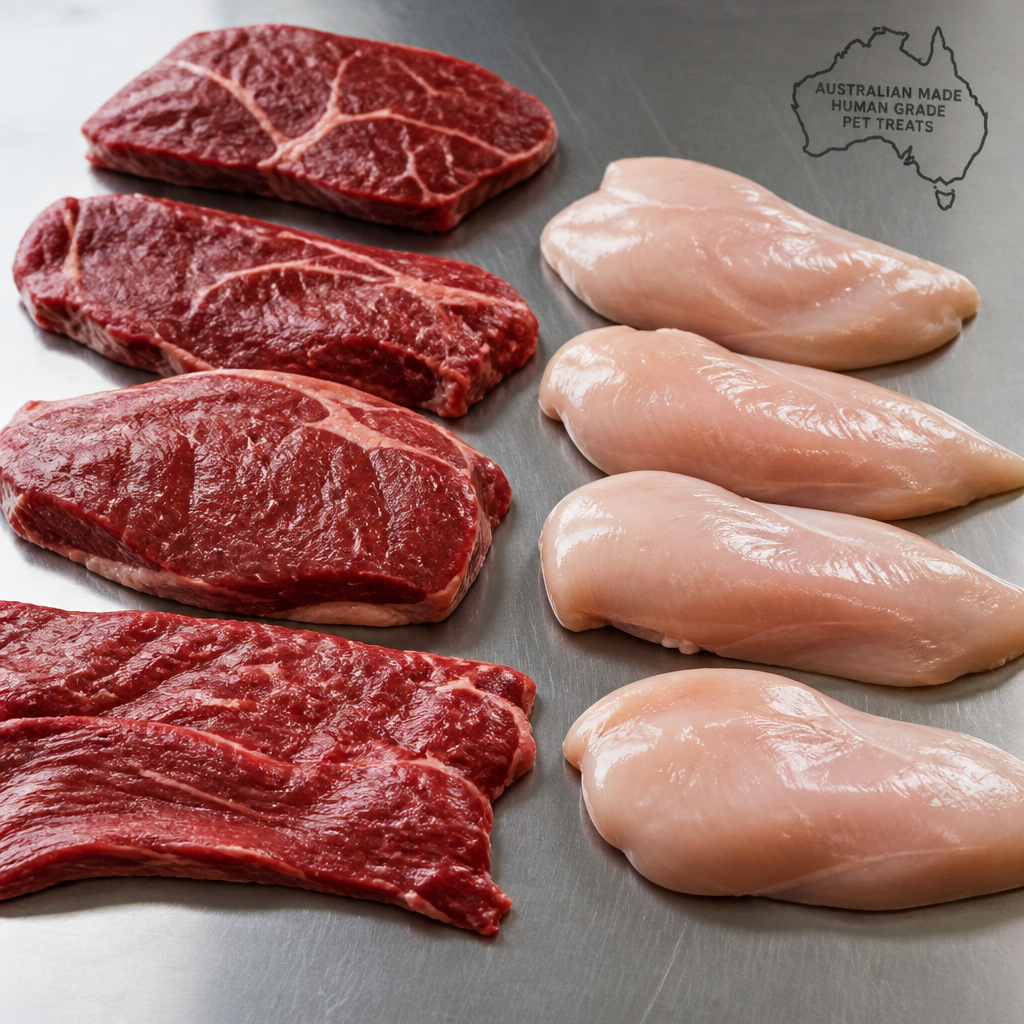
The whole process begins with a decision that most treat manufacturers skip entirely: using human-grade meat. That phrase has real meaning. Human-grade means the raw protein used in your pet's treat meets the same food safety and quality standards as meat you would buy for your own dinner. It is not offcuts, rendered meal, or mystery by-products. It is actual, identifiable meat.
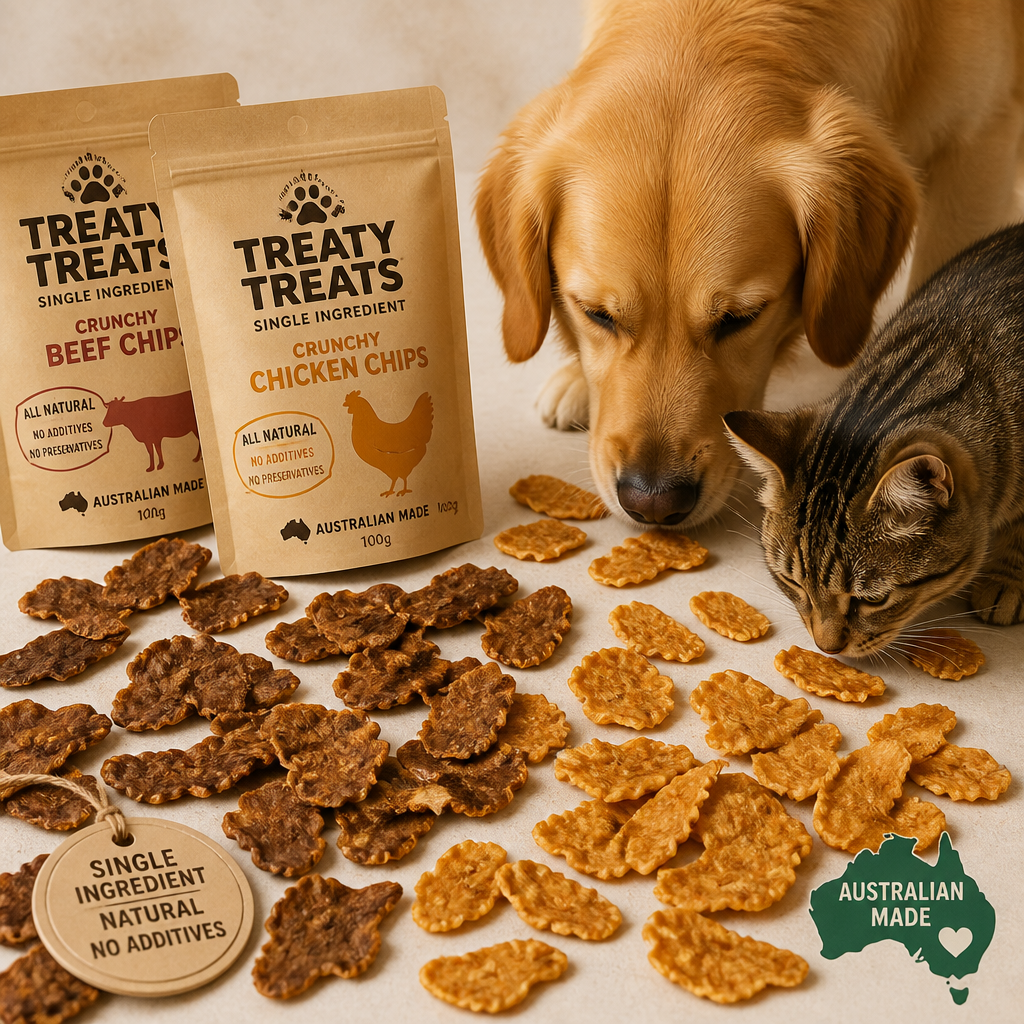
At Treaty Treats, the proteins are beef, chicken, and turkey. Each product contains exactly one of those. When you pick up a bag of our chicken chips, the ingredient list reads: chicken. Full stop. There is no hidden filler to bulk out the weight, no grain starch to hold everything together, and no flavour coating to disguise the taste of lower-quality raw material.
Sourcing this way costs more and requires more care in handling, but it means the quality of your pet's treat is set right at the very beginning, before any processing ever happens. Good inputs produce good outputs. It really is that straightforward.
Pro tip: When reading any pet treat label, look for the protein source to be listed as a whole, recognisable ingredient like "beef" or "chicken breast" rather than vague terms like "meat meal" or "animal derivatives." The simpler and more specific the list, the better.
The Air-Drying Process Explained
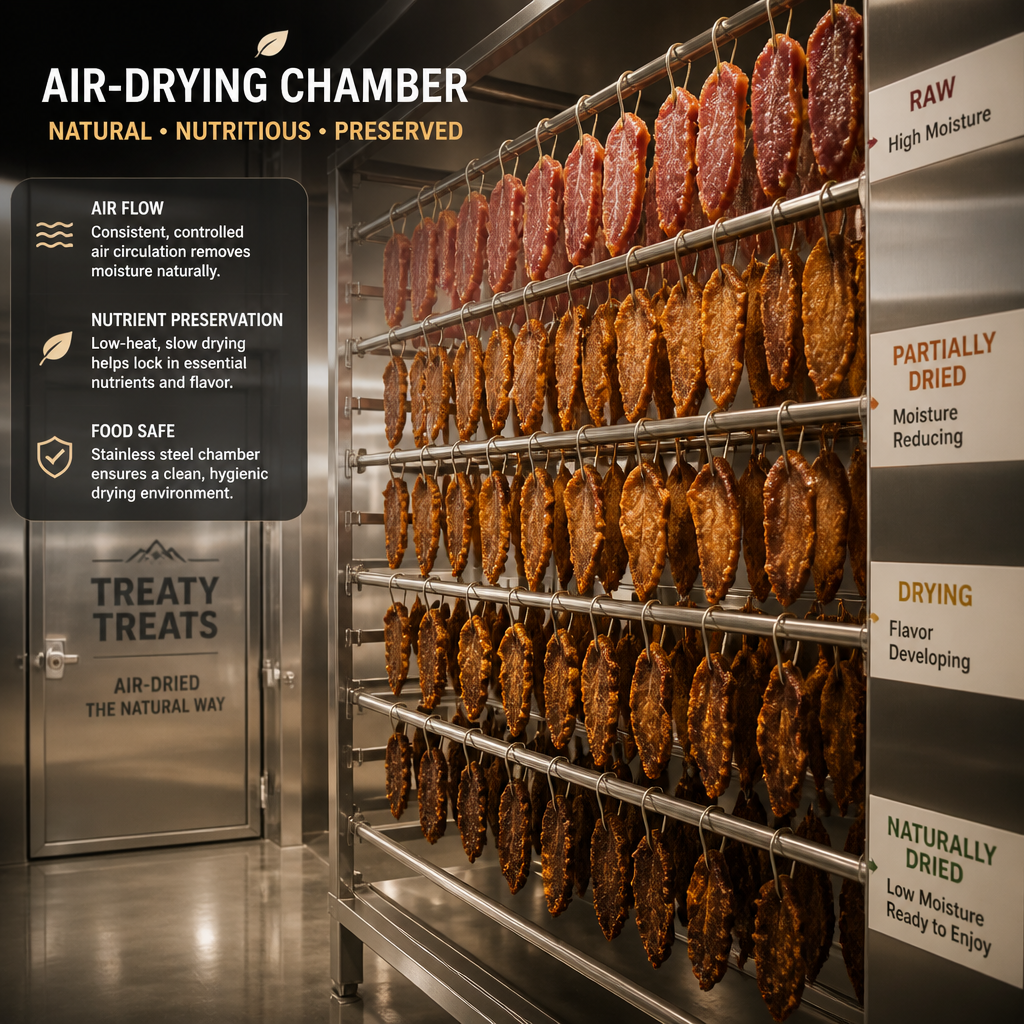
This is where the magic happens, and it is far more interesting than it sounds. Air drying is a slow, gentle method of removing moisture from meat using controlled airflow and low temperatures over an extended period. It is not the same as baking, which uses high heat and can denature proteins and destroy heat-sensitive nutrients. It is also not the same as freeze-drying, which uses a vacuum and sub-zero temperatures.
Why Low Temperature Makes a Difference
High-heat cooking methods, including the extrusion process used to make most commercial kibble and many conventional pet treats, expose ingredients to temperatures that break down natural enzyme activity, reduce vitamin content, and alter the amino acid structure of proteins. Air drying sidesteps this by keeping temperatures low enough to preserve the nutritional integrity of the meat while still doing the job of removing moisture thoroughly.
The result is a treat that retains the vitamins, minerals, and bioavailable protein that were present in the original raw meat, just without the water. What you're left with is concentrated nutrition in a shelf-stable, lightweight, crunchy chip your pet can crunch through happily.
The Role of Moisture Removal
Moisture is what allows bacteria, yeast, and mould to thrive. When the moisture content of a meat product is reduced to a sufficiently low level through the air-drying process, microbial growth is naturally inhibited. This is the same principle behind traditional jerky and dried meats consumed by humans for thousands of years. No artificial preservatives are needed because there is simply not enough water left in the product for harmful microbes to survive and multiply.
That is a genuinely important distinction. Many commercial pet treats achieve shelf stability through chemical preservatives like BHA, BHT, or sodium nitrite. Treaty Treats achieve it through the physics of the drying process itself.
When moisture is removed to a sufficiently low level through air drying, the growth of pathogens is naturally inhibited while the inherent vitamins, minerals, and enzymes found within the raw protein are retained. The finished product does not require any added preservatives to remain shelf stable.
Pro tip: If you're storing air-dried treats at home, keep the bag sealed and stored somewhere cool and dry. Once opened, treat them the same way you'd treat any natural dried food product. No refrigeration needed, but avoiding heat and humidity keeps them at their best.
Why Batch-Made Matters
Batch making is not a marketing phrase. It is a specific production philosophy, and it has real consequences for the treat sitting in your pet's bowl.
Large-scale commercial pet treat production runs product continuously, often across multiple facilities, with ingredients sourced from a variety of suppliers depending on price and availability. Quality control becomes statistical rather than hands-on. Problems can scale before anyone notices them. Recalls happen.
Small-batch production works differently. At Treaty Treats, each batch is a discrete run with a defined starting point, a traceable protein source, and a finished product that can be assessed before it ever reaches a bag. If something is not right with a batch, that batch does not ship. It does not get blended into a larger run where the issue gets diluted and hidden. The whole point of batch-made dog treats is that accountability is built into the process, not bolted on at the end.
There's also a freshness element worth mentioning. Because Treaty Treats are made in-house in smaller quantities and sold directly, they haven't been sitting in a distribution warehouse for months waiting to be picked. The gap between production and your pet's mouth is shorter, and that matters for any natural food product.
Comparing Treat-Making Methods
Not all pet treat production methods are equal, and understanding the differences helps you see why the approach Treaty Treats takes is worth the extra effort. Here's how the three most common methods compare.
| Production Method | How It Works | Key Trade-Offs |
|---|---|---|
| Air Drying (Treaty Treats method) | Slow moisture removal using controlled low-temperature airflow over time. No heat-cooking, no chemicals. Single-ingredient, batch-produced in Australia. | Slower and more resource-intensive per batch, but preserves the most nutritional integrity and requires no artificial preservatives or additives. |
| High-Heat Baking or Extrusion | Ingredients mixed, shaped, and cooked at high temperatures. Common for mass-produced treats and most conventional kibble. | Fast and cost-effective at scale, but high heat degrades heat-sensitive nutrients, enzymes, and natural proteins. Often requires artificial additives to restore palatability. |
| Freeze Drying | Raw ingredients are frozen then placed in a vacuum chamber where ice converts directly to vapour, removing moisture at sub-zero temperatures. | Excellent nutrient retention, but equipment is expensive and energy-intensive. Products are typically softer and more crumbly than air-dried treats. Often at a higher price point. |
The right method depends on what you're optimising for. If the goal is maximum nutritional preservation, natural shelf stability, a satisfying crunchy texture, and genuine simplicity of ingredients, air drying is the method that delivers all of those things together. That's why it's the process at the heart of every Treaty Treats chip.
What No Additives Actually Means
Saying a product contains "no additives" sounds simple, but it's worth unpacking what that actually means in practice, because the pet treat industry uses some terms loosely.
At Treaty Treats, no additives means no artificial preservatives, no added colours, no flavour enhancers, no binders, no fillers, no grain starches, and no sweeteners. The product you receive contains nothing that was not already present in the original piece of meat. This is not a "reduced additive" or "naturally preserved" formulation. It is genuinely additive-free, which is only possible because the air-drying process itself does the work that preservatives would otherwise do.
It also means there is no need for flavour enhancement. Human-grade meat that has been slowly air dried concentrates its own natural flavour as moisture is removed. The resulting treat is intensely savoury and aromatic in a way that processed, flavour-coated treats simply cannot replicate, because those products are often compensating for low-quality base ingredients by adding palatability enhancers on top.
If you have a fussy pet, this is often why a single-ingredient air-dried treat gets a reaction that a highly processed product with an impressive flavour profile does not. Real meat, properly prepared, speaks for itself.
Which Pets Benefit Most
Treaty Treats are made for dogs and cats, and the product works across a wide range of individual situations. But some pets benefit more noticeably than others, and it's worth knowing if yours is one of them.
Pets with Sensitive Stomachs
A common source of digestive upset in pets is not the protein itself, but everything around it. Grains, artificial preservatives, emulsifiers, and filler carbohydrates can all irritate the gut lining in sensitive animals. When you remove all of those and offer a single-protein treat with nothing else present, you eliminate most of the likely culprits. Many owners of pets with known sensitivities report that switching to a genuinely single-ingredient treat makes a visible difference.
Pets in Training
A good training treat needs to be small, high-value, easy to break into tiny pieces, and not so rich it upsets a dog's stomach after thirty repetitions in a session. The light, crunchy chip format of Treaty Treats ticks all of those boxes. You can snap off a small piece quickly, your dog will work hard for it because it smells and tastes like actual meat, and the high protein content means it's filling without being heavy.
Cats Who Are Notoriously Picky
Cats are obligate carnivores and their palates reflect that. Many cats reject heavily processed, plant-heavy treats immediately. The intense, natural meat aroma and flavour of a single-ingredient air-dried treat often succeeds where more processed options have failed. Turkey and chicken chips are particularly popular with cats for exactly this reason.
Frequently Asked Questions
Are Treaty Treats actually made in Australia?
Yes, completely. Treaty Treats are batch-made in-house in Australia. The meat is human-grade Australian beef, chicken, or turkey, and the entire production process from raw protein to finished chip happens locally. When you see "Australian made dog treats" on our packaging, it applies to the full process, not just a single step.
What is the difference between air drying and dehydrating?
The terms are sometimes used interchangeably, but there is a meaningful distinction. Traditional dehydration often relies more heavily on applied heat to speed up moisture removal. Air drying, as used by Treaty Treats, uses controlled low-temperature airflow over a longer period. This gentler process better preserves the enzymes, vitamins, and natural protein structures found in the raw meat, resulting in a nutritionally superior and more naturally flavourful treat.
How long do Treaty Treats last once opened?
Because the treats are shelf-stable through moisture removal rather than chemical preservation, they last well as long as you keep the bag sealed between uses and store it somewhere cool and dry. Avoid leaving the bag open in a humid environment. Treat them like you would any natural dried food: seal, store away from heat and moisture, and your pet will enjoy them all the way to the last chip.
Are these treats safe for puppies and kittens?
The single-ingredient, additive-free nature of Treaty Treats makes them a gentler option than many commercial treats. That said, very young puppies and kittens have specific nutritional needs, and it's always a good idea to check with your vet before introducing any new food to an animal still in early development. For dogs and cats past the early weaning stage, the high-protein, simple-ingredient profile is generally very well suited.
Why are Treaty Treats described as human-grade?
Human-grade means the meat used to make Treaty Treats meets the same food safety standards as meat produced for human consumption. It is not a lower-grade by-product, rendered meal, or pet-food-grade protein. Using human-grade meat from the start means you know exactly what quality of ingredient your pet is eating, and it means Treaty Treats can genuinely claim a single-ingredient product with nothing to hide.
Can I use Treaty Treats as a meal topper as well as a standalone treat?
Absolutely. The chips can be crumbled over your pet's regular meal to add a boost of natural protein and a burst of genuine meat flavour that often encourages fussy eaters to clean their bowl. The turkey range works especially well as a food topper for both dogs and cats. Just keep the amount proportionate to your pet's overall daily intake so treats remain a supplement rather than a meal replacement.
We'd love to hear how your pet reacted to their first Treaty Treats chip. Drop a comment or tag us on social media and let us know which flavour was the winner in your household.
We would love your feedback and any insights you would share with others. What perspective would you add?
References
- How air drying removes moisture and preserves nutrients in raw pet treats
- How dehydration and low-heat drying compare to high-heat extrusion for pet treat nutrition
- The nutritional differences between dehydrated and air-dried pet food
- What makes natural single-ingredient dehydrated dog treats different from conventional options
Follow Us
Subscription Subscribe to our newsletter and receive a selection of cool articles every weeks

Real Talk & Tail Wags

dog treat enrichment ideas
Discover 5 practical dog treat enrichment ideas, from puzzle feeders to snuffle mats, that make treat time fun, rewarding and...

best dog treats Australia
Cheap dog treats can cause tummy upset, weight gain, and hidden costs. Learn what bargain snacks contain and how to...

dog treat transition guide
Switching dog treats naturally? Follow this gentle dog treat transition guide to avoid tummy trouble and keep your dog happy....


